
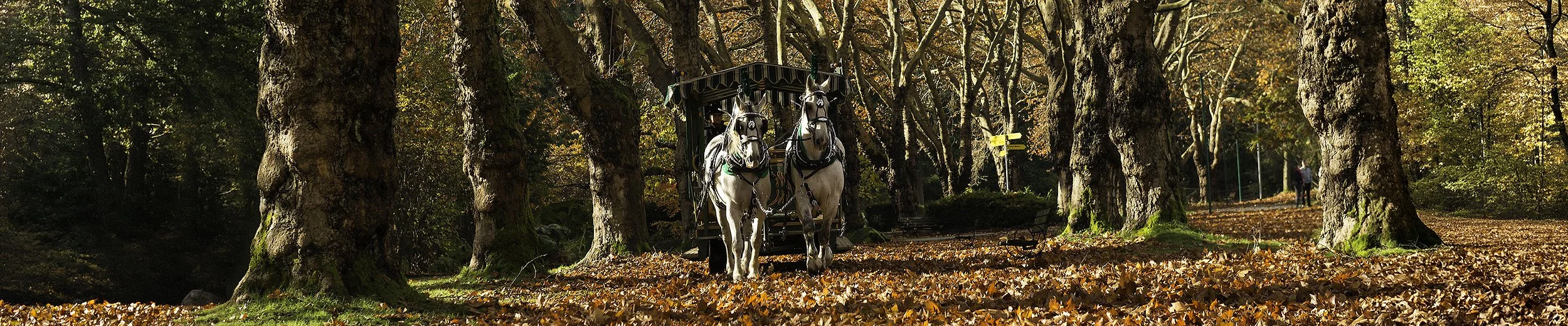

Frequently Asked Questions
About our tour
How long is the tour?
Our tour is approximately 1 hour long — the perfect amount of time to relax and enjoy the beauty of Stanley Park.
What will we see on the tour?
Along the way, you’ll enjoy views of Coal Harbour, the Royal Vancouver Yacht Club, HMCS Discovery Naval Base, the famous Totem Poles, the 9 O’Clock Gun, Brockton Point Lighthouse, the Girl in a Wetsuit statue, Burrard Inlet, the North Shore Mountains, Lumberman’s Arch, the Rose Garden, and monuments honoring influential historical figures.
What is the tour experience like?
This is a fully narrated 1-hour tour of the eastern side of Stanley Park. Your knowledgeable carriage driver will share stories, history, and fun facts that bring the park’s sights and sounds to life. Enjoy live narration throughout the tour from your carriage driver — we do not use recording.
Are there any stops during the tour?
Yes! About 10 minutes into the journey, we stop at the Totem Poles so guests can step off the carriage and take photos.
We also make a few short pauses along the route for scenic photo opportunities and to give our horses a brief rest. Traveling at a relaxed pace of 3 miles (5 kilometers) per hour, the tour gives you plenty of time to take in the scenery and capture memorable photos along the way.
Can I hop-on and hop-off during the tour?
This is not a hop-on, hop-off tour. For safety and scheduling reasons, guests may only exit the carriage during the approximately 10-minute stop at the Totem Poles. After the stop, you will re-board the same carriage to continue the remainder of the tour.
How often do tours depart?
Departure times vary depending on the season and weather conditions. Tours typically leave every 20–45 minutes.
How much of Stanley Park does the tour cover?
The tour follows a 2.5-mile (4 kilometers) loop covering many of the eastern side’s most popular attractions, with a wonderful mix of forest scenery and waterfront views.
Go to our main page and scroll down to see the map of the tour route.
https://www.stanleypark.com/
How many people fit on a carriage?
Each carriage comfortably seats approximately 20–25 guests.
Can children ride on their own?
Children are welcome on the tour, but they must be supervised by an adult at all times for everyone’s safety and enjoyment.
Are the carriages wheelchair accessible?
Yes — most of our tours are wheelchair accessible when returning to the Information Booth.
However, our final tours of the day are not wheelchair accessible, as those tours drop passengers off at the Stanley Park Pavilion, and at that drop off location the wheelchairs unfortunately cannot be unloaded from the carriages. We recommend planning your visit at least two hours before our last tour departure of the day.
To ensure availability and for additional assistance or accessibility questions, please visit our Contact page to reach out to us.
https://www.stanleypark.com/contact
What happens if it rains, or the weather is bad?
We operate rain or shine! Our carriages are covered with a canvas roof for protection from the elements, and on colder days we provide cozy lap blankets for your comfort.
What if my tour is full?
No problem! Tours depart frequently throughout the day. If you have pre-purchased tickets, please visit our Ticket Booth beside the departure area to receive your boarding pass. Our staff will help you board the next available tour.
Can I bring my dog? Is there an extra fee?
Absolutely — friendly dogs are welcome aboard at no extra charge! We simply ask that all four-legged guests remain calm and respectful around the horses and other passengers.
Do you offer private tours?
Yes, private tours are available and must be booked in advance. We have a variety of carriages to select from. Please visit our Private Tours page for more information.
https://www.stanleypark.com/private-reservations
Can I book a regular tour in advance?
We do not take reservations for specific departure times. However, you are welcome to purchase your tickets in advance through our website.
Upon arrival, please check in at our Ticket Booth, where our staff will place you on the next available tour and provide you with a boarding pass.
Group booking requests are available for parties of 10 passengers or more. Simply submit your booking request to us, and our team will get back to you to confirm availability and assist with your reservation.
https://www.stanleypark.com/buy-tickets
Rates
What are the ticket prices?
Please visit our Schedule & Rates page for the most up-to-date pricing information.
https://www.stanleypark.com/schedule-rates
Are prices listed in Canadian dollars?
Yes, all prices are listed in Canadian dollars (CAD).
Do you offer a family discount?
We do not currently offer a family discount. However, we do offer a 20% group discount for bookings of 10 guests or more.
Is it cheaper to purchase tickets online?
No, ticket prices are the same online and in person.
Directions
How do I get to your location?
Stanley Park is accessible by public transit, car, bike, or on foot.
You can find the information on how to find us here.
https://www.stanleypark.com/directions
How far is the departure location from the bus stop?
It is approximately 300 meters (990 feet) walk from the Stanley Park Bus Loop. Simply follow the path toward Coal Harbour and look for the sandwich board signs along the way.
Where does the tour start?
Tours depart from: 735 Stanley Park Drive, Vancouver, BC V6G 3B3
https://maps.app.goo.gl/v4zsdck9ZTXukdd38
Is there parking nearby?
Yes, paid parking is available directly beside our departure location as well as throughout Stanley Park. It is the same lot number 62 for all parking lots within Stanley Park.
Please note that all parking meters in Stanley Park accept credit card payments only.
Kindly remember that most of the park operates with a one-way road system for vehicles.
https://www.easypark.ca/find-parking/locations-and-lot-information/lot-details/stanley-park
Where does the tour end?
Most tours return to the original departure location. However, the final tour of the day ends at the Stanley Park Pavilion, which is approximately 200 meters (660 feet) walk back to the departure area.
https://maps.app.goo.gl/UqHnYjfVx8rfm8Zt8
Need help getting back?
Parking Lot: It’s a short 200 meters (660 feet) downhill walk back to the parking area.
Bus: The Hop-On Hop-Off Bus and the public #19 bus stop are both less than a 2-minute walk from our Stanley Park Pavilion drop-off location.
Taxi / Uber / Lyft: Please request your ride to the Stanley Park Pavilion at 610 Pipeline Road.
Walking: Your carriage driver will gladly point you in the right direction to continue your visit.
Are taxis available in Stanley Park?
Yes, taxis occasionally drive through Stanley Park, though availability can be limited. We recommend saving the phone number of a local taxi company before your tour so you can easily arrange a pickup afterward. Ride-share services such as Uber and Lyft are also available in Vancouver.
About the care and treatment of our Gentle Giants
Are the horses well looked after?
Yes — absolutely.
Our horses’ wellbeing is our highest priority. We spend a great deal of time with our team making sure every horse is happy, comfortable, healthy, and receiving the very best species-specific care. From their nutrition and exercise routines to rest schedules and social time with other horses, everything is designed around their physical and mental wellbeing.
We also work closely with a dedicated team of equine veterinarians who oversee the health of our horses. Our veterinarians visit regularly to perform wellness checks and monitor each horse’s condition. In addition, every horse receives routine dental care, including teeth floating when needed — a process where sharp edges on a horse’s teeth are gently filed down to help them chew comfortably and maintain proper oral health.
How much does the carriage weigh?
It can range from approximately 700 to 2,500 pounds (315–1,140 kilograms), depending on the carriage type, passenger load, and operating conditions. Our horses are carefully matched to the work they do, and their fitness, size, and strength are always taken into consideration to ensure they are comfortable while working.
Each one of our Stanley Park Horse-Drawnn Tours’ wheelchair accessible carriages took over 1000 work hours to construct and was made with the use of local materials wherever possible. Some of the floors are cedar, varnished to a high shine. Anti-skid maple leaves made from ground walnut shells adorn the floor. The aluminum frame, free-standing tongue, proper lighting, and hydraulic brakes significantly reduce the work for the horses while ensuring we operate safely and responsibly as road users in compliance with traffic laws. These carriages are light enough that often a single adult human can move them.
How many hours do the horses work?
Typically, our horses work between 3–4 hours per day. On a full working day, a horse will usually complete 3–4 one-hour tours. Their schedules are carefully managed to make sure they are not overworked and have plenty of time to rest between tours.
How many breaks do the horses get during the day (year)?
During the working day, horses receive a minimum 30-minute break between tours. Tours also include regular scheduled stops where the horses can pause and rest.
Across the week, each horse’s schedule is tailored to their fitness, age, and individual personality. Most horses work 3–4 days in a row followed by 1–3 days off.
Our horses work within the park from March through December and enjoy a winter break of approximately 3–4 months each year. During the summer season, they also typically receive a month off after around three months of work.
If a horse is not feeling well, we always have additional horses at our barn ready to step in. This means there is never any pressure for a horse to work if it is unwell. The health, comfort, and wellbeing of our horses always come first.
Does the pavement hurt their hooves?
No, it does not.
Our horses wear custom-made, properly fitted steel horseshoes designed specifically for carriage work. The shoes are enhanced with brazed Borium at the toe and heels, providing additional traction on pavement surfaces while also helping reduce wear on the horseshoes themselves. Their hoof care is carefully monitored by our professional farrier to ensure their feet remain healthy, balanced, and comfortable.
For some horses that require extra support, as an added precaution to help prevent hoof sensitivity, we use specialized leather pads along with soft sponge cushioning between the hoof and horseshoe to provide additional support, shock absorption, and overall comfort.
Does the weather affect them?
Yes — just like people, horses are affected by the weather. However, horses are incredibly adaptable animals and become very well suited to both hot and cold conditions when given time to adjust seasonally.
In winter, horses grow thick winter coats that help keep them warm, and the natural heat created by movement and digesting food also helps regulate their body temperature. On especially cold days, they wear blankets during breaks for extra comfort.
In summer, they shed their winter coats and naturally cool themselves by sweating. Between tours, our horses can enjoy cold showers and high-powered fans to help them stay cool and comfortable on warm days.
Do the horses enjoy this work? How can you tell?
Yes — although not in exactly the same way humans enjoy work. Horses experience wellbeing differently, and it’s important to understand their needs and behavior from a horse’s perspective. Our horses are draft horses, a breed historically developed for pulling and farm work, and they are naturally well-suited for this type of activity.
Here are a few reasons why our horses thrive in this environment:
They are social animals.
Horses are herd animals and naturally prefer the company of other horses. Our horses work in pairs, so they are never isolated or lonely. Throughout the day they interact, communicate, and socialize with one another.
They enjoy movement and stimulation.
Horses are designed to move. In the wild, they naturally travel throughout the day. Their work provides healthy exercise, mental stimulation, and varied terrain including gentle uphill and downhill sections that keep them physically engaged.
Their behavior tells us a lot.
Happy, healthy horses show clear signs of comfort and confidence. Our team closely monitors each horse’s behavior, appetite, energy levels, and willingness to work. Because we know our horses so well, we can quickly recognize when a horse is enjoying their routine or when they may need extra rest or support.
We rotate our horses between the barn and pasture throughout the year, carefully alternating teams to ensure each horse receives extended periods of rest. Every horse enjoys several months off at a beautiful farm in the Fraser Valley, where they can relax, graze, socialize with other horses, and simply enjoy being horses.
https://www.youtube.com/watch?v=gt9eYZFsc2I
How often do you need to replace their horseshoes?
Usually every 5–6 weeks.
Depending on the season and how quickly their hooves grow, our farrier visits regularly to replace their shoes. This includes removing the old horseshoes, trimming excess hoof growth, and fitting fresh shoes to keep the horses comfortable and properly supported.
What do the horses eat and drink?
Our horses are big eaters, enjoying a carefully prepared diet designed to keep them healthy, strong, and full of energy.
Each horse consumes approximately 31–44 pounds (14–20 kilograms) of hay daily, along with a nutritious home-made mash made from a custom blend of grain, bran, molasses, flax, corn, barley, beet pulp, vitamins, and minerals. Warm water and apple cider vinegar are added to improve flavor and support healthy digestion.
And perhaps most impressive of all — each horse can drink up to 26 gallons (100 liters) of water every single day, especially during warmer weather!
Until what age do the horses work?
Most horses retire by around 20 years old.
That said, every horse is different. If an older horse is still healthy, comfortable, and enjoys light work, they may continue participating in occasional special events such as weddings or private bookings. Our older horses are incredibly experienced and often still enjoy being part of the team in a more relaxed role. In many cases, they also help train and guide younger horses, passing along calm behavior and familiarity with the routines of carriage work.
What happens when the horses retire?
When our horses retire, they move on to carefully selected retirement homes where they can relax and simply enjoy being horses. We work with a trusted network of contacts to find the right retirement environment for each individual horse, ensuring they continue to receive the care, attention, and companionship they deserve throughout their retirement years.
Many of our retired horses go on to enjoy a meaningful next chapter at rehabilitation centers, therapeutic equine programs, and specialized care facilities. Some continue helping people through equine-assisted therapy, offering comfort, connection, and support to children, adults, and individuals with special needs. Others spend their retirement in peaceful settings where they can unwind and enjoy a slower pace of life after years of dedicated work.
No matter where they retire, we are committed to ensuring our horses are placed in safe, supportive homes where they can continue to thrive and be appreciated for the incredible animals they are.
About Draft Horses
What type or breed are the horses?
Our herd is made up of several different breeds of draft horses, which are a group of horses traditionally bred for pulling and farm work.
Our horses include Percherons, Belgians, Clydesdales, and Spotted Drafts — all known for their strength, calm temperament, and gentle nature.
You can learn more about draft horses and different breeds here:
Draft Horse - https://horse-canada.com/breeds/draft-horse/
Belgian - https://horse-canada.com/breeds/belgian-draft-horse/
Clydesdale - https://horse-canada.com/breeds/clydesdale/
Percheron - https://horse-canada.com/breeds/percheron/
Shire - https://horse-canada.com/breeds/shire/
Suffolk - https://suffolkhorsesociety.org.uk/about/about-the-suffolk-horse/
What is the lifespan of a horse?
Horses typically live between 27–33 years of age, although many can live even longer with excellent care. Ponies often have longer lifespans than larger horses.
In the wild, horses often have significantly shorter lifespans due to the many challenges they face without human care. Illnesses, untreated infections, parasites, dental problems, hoof deformities, injuries, poor nutrition, and harsh weather conditions can all impact their health and longevity. For example, untreated dental issues can make it difficult for a horse to properly chew and maintain weight, while neglected hoof problems can lead to pain, lameness, and difficulty moving. Injuries or infections that would be treatable under veterinary care may also become life-threatening in the wild.
Under professional care, horses benefit from regular veterinary attention, balanced nutrition, routine dental and hoof care, safe shelter, and carefully monitored exercise programs that help support their long-term health and wellbeing.
How much do the horses weigh?
Our horses weigh between 1,800–2,200 pounds (815–1000 kilograms).
On average, most of our horses weigh around one tonne!
Can you ride them?
Technically, yes — draft horses can absolutely be ridden. However, many of our horses have been specifically trained for carriage work rather than riding under saddle.
Some of our horses do have riding experience, but on their days off we prefer to let them relax and simply enjoy being horses.
You might enjoy seeing Loni’s appearance at the 111th Grey Cup in Vancouver:
https://www.youtube.com/watch?v=ZteJrEyeifI
How much can draft horses pull?
Draft horses are incredibly strong animals. Under ideal conditions, a single draft horse can pull up to five times its own body weight. As a team of two, they can pull up to fifteen times their combined weight.
For our horses, that could mean a maximum pulling capacity of around 15 tonnes. However, when working within the park, we operate well below those limits to ensure the horses remain comfortable and are never overexerted during the day.
Draft horses have played a major role in human development for centuries, especially before mechanization. Their strength, endurance, and steady temperament made them essential in agriculture, forestry, mining, and urban transport.
In forestry, breeds like Belgian Draft Horse and Percheron were commonly used to pull heavy logs out of forests with minimal damage to the surrounding land. Unlike early machines, horses could work in tight, uneven terrain and were often preferred for selective logging operations.
In agriculture, draft horses were the backbone of farming life. They pulled plows, seed drills, and harvest equipment, enabling large-scale cultivation long before tractors existed. Entire farming systems depended on their strength and reliability, particularly in North America and Europe during the 18th and 19th centuries.
In mining, smaller horses and ponies—such as the Shetland Pony—were famously used underground to haul coal carts through narrow tunnels. These animals worked in difficult, low-light conditions and were vital to the industrial revolution’s energy supply chain.
In cities, draft horses also powered transportation and logistics, pulling streetcars, delivery wagons, and construction materials that built modern infrastructure.
Overall, working horses were central to human progress for thousands of years. They enabled food production, resource extraction, and transportation at scale—forming the foundation for the industrial and agricultural systems that followed.